Getting to Know Thermal Insulation
Published 7 Jul 2023 · Updated 31 Aug 2026 · 5 min read
In this article
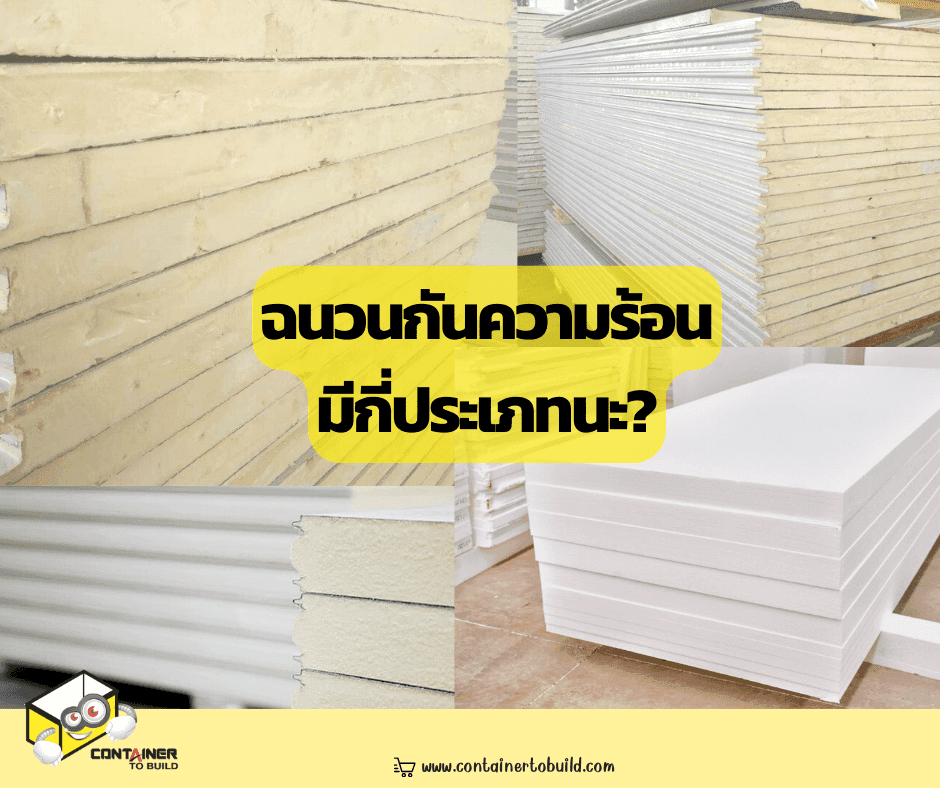
How many types of thermal insulation are there, and what are the properties of each type? (Insulation sheet for Architectural)
What is thermal insulation? It is a material that blocks heat from passing through to other parts. It is lightweight and made up of a large number of tiny air bubbles, which trap heat inside the bubbles so that it is not carried on to other parts. In home building and decoration, it is commonly installed on the roof structure to reduce the intensity of sunlight passing into the house and heating it up. It can also be installed at the ceiling.
Each type of insulation has a different heat resistance. Good insulation must reduce the heat passing from one side to the other to a minimum. The lower the thermal conductivity coefficient (K value), the better the insulation resists heat.
How many types of thermal insulation are there?
1. Aluminium foil insulation (Aluminium Foil)
It takes the form of a double-sided aluminium foil sheet with a thin, smooth and tough surface, making it fairly durable and not easily torn. Its function is to reflect heat. If you choose pure aluminium foil on both sides, it can reflect as much as 95-97% of heat. Aluminium foil insulation helps reflect heat but does not do much to stop heat entering the house, so it is usually installed at the roof structure and should be used together with other types of insulation. However, this type of insulation is easy to find, not very expensive, and contains no irritants or toxic substances.
Advantages/properties
- Low thermal emissivity of the aluminium surface
- Maximum heat reflection efficiency of 97%
- Resistant to tensile force, so it does not tear easily
- Thermal insulation with no substances that are irritating or toxic to humans
- Affordable and easy to find
- Fairly good resistance to moisture
Disadvantages/limitations
- It has no sound insulation properties
- Although it reflects heat, it does not stop heat entering the house, so it should be installed at the roof structure, with other types of insulation installed to add heat insulation
Approximate price: from 1,000 THB per roll
2. Cellulose fibre insulation (Cellulose)
Cellulose fibre thermal insulation comes from a recycling process in which used wood pulp or paper pulp is broken down finely and bound together with borax. This type of insulation comes in 3 forms: fibre compressed into sheets, blanket, and spray-applied. Today some brands have adapted it to resist the spread of fire by adding fire retardants to the paper pulp, so that it can resist fire to a certain level, or when it catches fire it smokes and goes out by itself, but in this case it must be mixed with the correct components. Cellulose fibre insulation is therefore suitable for room walls or building walls, as well as under building roofs.
Advantages/properties
- Some brands of cellulose fibre insulation can insulate up to 90% of heat
- Some brands of cellulose fibre insulation can reduce echo and reverberation by up to 75%
- The material carries a low risk of skin irritation
- Available in several forms: fibre compressed into sheets, blanket and spray-applied
- It is a recycled material
Disadvantages/limitations
- With the spray-applied form, density control may not meet the required standard, which can cause the insulation to gradually settle
- As a natural fibre it is flammable, so fire retardants are usually added
- It can come loose and flake off
- Not very resistant to water and moisture
3. Polyurethane insulation (Polyurethane)
Polyurethane insulation, or PU foam insulation, is a foam-injection technology for heat protection. It has a fine texture and a closed-cell structure with a large number of air pockets, called air gaps, so it adheres very well to the underside of roof sheets. It is suitable for industrial factories that have problems with heat dissipation. Polyurethane insulation comes in 2 forms: prefabricated, supplied together with roof sheets, and spray foam. We have therefore chosen PU foam insulation to keep out heat in both the walls and the roof.
Advantages/properties
- The best heat insulation compared with other types of insulation
- Can reduce solar radiation passing through the roof by more than 90%
- Good protection against noise
- Very good protection against leaks, moisture and rust
- Works well with all types of roof, such as tiles, corrugated galvanised sheet, aluminium, concrete and steel
- Fine texture that adheres very well to the underside of roof sheets
- Spray polyurethane foam can be sprayed under existing old roofs
- Can clad every side of cold room walls
Disadvantages/limitations
- In the event of fire it can burn at that spot, but the fire does not spread
- In a fire, toxic smoke may be produced, which is hazardous to health if inhaled
- It has a low melting point and may change form if exposed to extreme heat
- If the installer lacks expertise when spraying, the insulation may scatter
Starting price approximately 300 THB/m²
4. Calcium silicate insulation (Calcium Silicate)
Calcium silicate insulation is a porous insulation made from sand, siliceous material and lime water, followed by fibres for reinforcement. It usually contains no asbestos, so it has no toxic substances. Calcium silicate insulation comes with either mineral fibres or synthetic fibres. It is an insulation that can adjust quickly to each temperature according to working conditions. It can be cut and joined like gypsum board but has heat-resistant properties, can be painted over and is fairly fire-resistant. It is commonly used to clad pipes and vessels in industrial processes.
Advantages/properties
- Heat-resistant properties
- Contains no asbestos, environmentally friendly
- Good sound absorption
- High density, good impact resistance
- Can be cut and joined or painted over
- Good fire resistance, low chance of igniting or spreading fire
Disadvantages/limitations
- Water vapour penetrates easily
- High water absorption
Approximate price: 150 – 2,000 THB/sheet
5. Glass wool insulation (Microfiber)
Glass wool insulation consists of small fibres in a non-solid structure resembling pores, so it can greatly reduce the amount of heat passing into the building. In addition, the foil sheet on the underside helps stop heat inside the insulation from escaping. It also has good sound insulation properties, is lightweight and highly flexible, so it recovers quickly after being compressed.
Advantages/properties
- Low thermal conductivity
- Helps reduce the amount of heat passing into the building
- Good protection against noise
- Good flexibility, recovers quickly after being compressed
- Lightweight, durable and does not deteriorate
- Good protection against insects and mould
Disadvantages/limitations
- No fire-spread resistance
- The fibres may cause irritation
- Small particles may be released as it deteriorates
- Not suitable for use in open areas
- The binder may burn if it catches fire
- High water vapour penetration rate, so it should have a vapour barrier covering
Approximate price: from 1,500 THB per roll
Source https://www.wazzadu.com/