Gypsum Board, SmartBoard, Viva Board: Which Should You Use?
Published 7 Jul 2023 · Updated 2 Sept 2026 · 5 min read
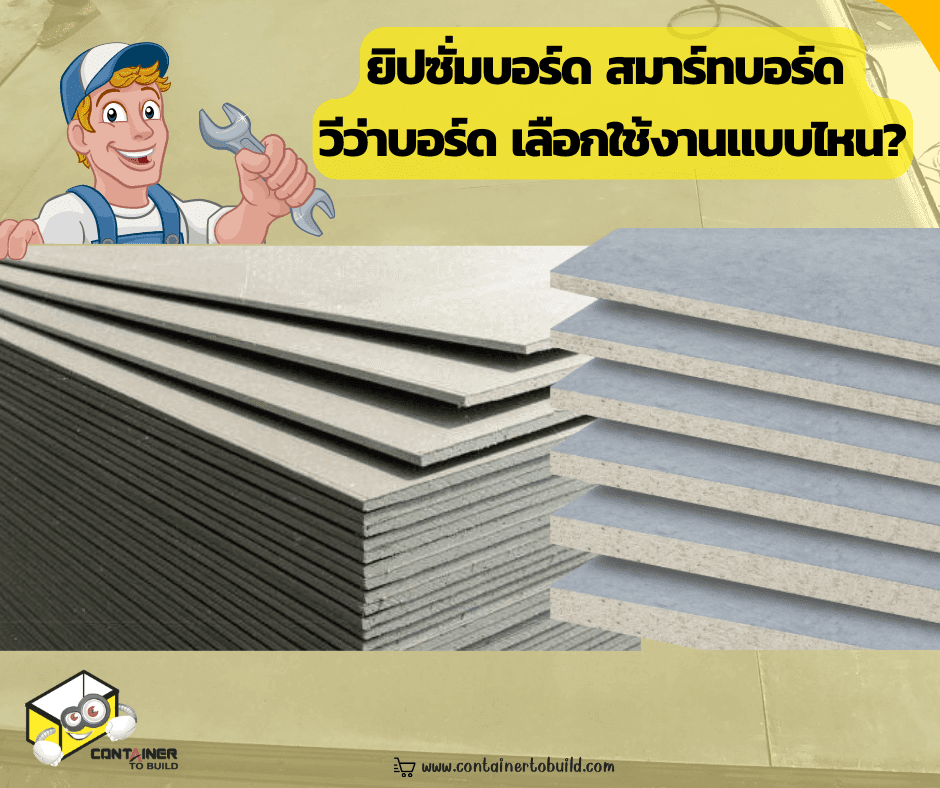
“Partitioning a room, building office walls, extending a kitchen: what should you use? Gypsum… SmartBoard… Viva Board.” We all know these three names as materials for lightweight walls, but we can’t help wondering which kind of work each one suits. Can they replace each other? Which one is strong and durable? So we did some homework on gypsum board, fibre cement board (SmartBoard) and cement-bonded particle board (Viva Board) to share with you.
These lightweight wall materials are used for extensions, decoration, ceilings and partition walls. They are also easy to install, quick to work with and save a lot of structural work. Anyone who wants to use them as main structural walls is not breaking any rules, but their service life will be shorter and they are less strong than brick walls or lightweight concrete blocks. As for choosing between these lightweight wall boards, they are similar but not exactly the same, because of differences in the raw materials and production methods used.
Raw materials and production process
Gypsum – made from pressed gypsum mineral powder, faced front and back with paper. It produces a wall board with a smooth surface, but it is brittle, breaks easily and has problems with moisture.
Fibre cement board – (many people call it SmartBoard) made from cement mixed with cellulose fibre (asbestos-free) and silica sand, then cured with high-pressure steam. It is stronger than gypsum board and can be bent, but still has some problems with moisture. It has a smooth face that can be left exposed, painted or skim-coated, and a rougher face that is better for tiling over because adhesion is better than on the smooth side.
Cement-bonded particle board – (commonly known as Viva Board) made from wood sawdust mixed with cement, then formed under very high pressure and baked again to remove more moisture. It is tough, has few moisture problems and a smooth surface. Its face looks similar to fibre cement board, but in cross-section you can see wood particles embedded in the cement.
Size – thickness
Gypsum board
– Size 120 x 40 cm
– Thickness 9, 12, 15 mm
– Price 140 – 300 THB/sheet, depending on thickness and type of facing, such as paper, foil or moisture-resistant sheet
Fibre cement board
– Size 1.20 x 2.40 metres
– Thickness 3.5, 4, 6, 8, 10, 12, 16, 18 mm
– Priced from under one hundred baht per sheet up to five hundred baht, depending on thickness
Cement-bonded particle board
– Size 1.20 x 2.40 metres
– Thickness 8, 10, 12, 16, 20, 24 mm
– Price from 300-odd baht up to 800-odd baht, depending on board thickness
Installation
Gypsum board
– Installed on a frame, fixed with screws or nails
Fibre cement board
– Installed on a frame, must be fixed with screws
Cement-bonded particle board
– Installed on a frame, must be fixed with screws
Strengths
Gypsum
– Lightweight
– If no frame is built, it can be fixed with adhesive mortar instead. Joints between boards can be skimmed more smoothly, and it is easy and quick to drill, cut and repair
Fibre cement board
– Expands, shrinks and warps less than gypsum; termites don’t eat it
– Can be bent
– Withstands sun and rain
– One face is smooth and can be left exposed, for those who want a bare-concrete wall look
Cement-bonded particle board
– Flexible like wood, tough like cement
– Withstands sun and rain, does not swell, rot or decay, termites don’t eat it, no mould
– Attractive surface that can be shown off without further work, or, if you want it to look even better, it can be painted, plastered or tiled
Weaknesses
Gypsum
– Eaten by termites, cannot get wet, carries little load, brittle, cannot be tiled over, unattractive surface that must be painted or plastered over
Fibre cement board
– Can expand, shrink and warp, more or less depending on site conditions
– Joints between boards are hard to skim smoothly, and drilling, cutting and repairing are more difficult
– Unattractive surface that needs another layer of finish for appearance
– If used in very humid areas, such as ground-floor walls or walls in contact with soil or water, it must first be coated with a moisture-proofing layer to prevent paint peeling
Cement-bonded particle board
– Can also expand, shrink and warp, more or less depending on site conditions
– The thicker it is, the heavier it gets
– If used in very humid areas, such as ground-floor walls or walls in contact with soil or water, it must first be coated with a moisture-proofing layer to prevent paint peeling
Uses
Gypsum
– Used for interior walls, room partitions, ceilings and areas that rarely encounter moisture or get wet. If it is to be used for exterior walls or frequently humid areas, such as kitchens, bathrooms or eave soffits, choose a moisture-resistant model
Fibre cement board
– Can be used for both interior and exterior walls, as underlay beneath roofs or as a base before laying flooring. It is easier to choose because it comes in clearly separated types; you can choose straight away whether you need fibre cement board for ceilings or for walls. Tiles can be laid over fibre cement board with adhesive mortar, or it can be made into a double wall with heat-insulating foam in the middle
Cement-bonded particle board
– Can be used for floors, walls and ceilings, inside or outside, mainly depending on board thickness. The thinnest 8 mm boards are used for decorative ceilings and floor underlay; for wall cladding, choose thicker 12 mm boards. Moving up to 16 mm, they are used as roof underlay or building facade cladding, while thicknesses of 20 mm and above are used for floors because they are thick enough to carry extra load, and the price rises accordingly
Summary
If you just want to partition a room at home, divide office space or partition an indoor area, and you don’t need great strength, high load-bearing capacity or resistance to sun and rain, choose gypsum board. For exterior walls or ceilings, kitchen walls, or exterior walls of an extension to an existing house that must withstand sun and rain, choose fibre cement board or cement-bonded particle board. But for floors that must carry loads, cement-bonded particle board is better.
One more word of advice: choose materials that suit the use and the environment of the area too. Don’t choose only because something is lower-priced or more economical, because if that material has problems later, the cost of replacing or repairing it may be higher than the price of the material and give you a real headache.
Website credit: http://community.akanek.com/th/content/